 Kuebix is now a part of FreightWise
Now that carriers have announced their 2026 peak surcharges, managing parcel costs is critical to protecting profit margins and ensuring a seamless customer experience. Taking a proactive, data-driven approach can significantly reduce your surcharge exposure. Below, we examine key cost-mitigation strategies, ranging from smart dates and return planning to smart packaging, multi-package shipments, data analytics, and multi-carrier models.
1. Target “Smart Dates”
Marketing teams may not be aware of specific dates or times when parcel shipments may drastically increase. Work with your marketing team to incentivize or encourage customers to order during non-peak windows.
- Mid-Season Strategy: In 2026, the most expensive window is between Nov. 22/23 and Dec. 26/27. Shipping just one day outside this window can save $0.25 to $60.00 per package. Review your operational calendar to identify which items can be shipped a few days earlier or later to avoid the highest-cost demand periods. The table below highlights the difference in list rates when shipping on smart dates versus higher-cost dates.
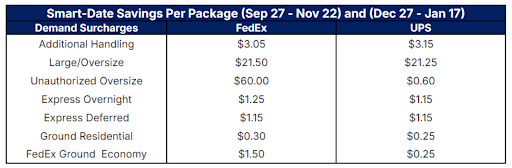
- Early Bird: Creating campaigns to push early-bird discounts before the demand season begins September 27/28 can make a meaningful difference.
- Post-Peak: Encourage non-critical shipments after the demand season ends on January 17th.
2. Plan for Returns
Ensure that your return policy is aligned with the demand surcharge timeline. There are actions you can take if you are paying for a percentage or the total cost of returns.
- Incentivize customers to return shipments during the smart dates.
- Extend your return dates and reward customers who return after January 17th when the demand period is over. This will eliminate the demand surcharges entirely and the cost savings range from $0.50 to $590.00 per package.
- Encourage customers to return items in-store.
3. Implement “Smart Packaging”
Many shippers use oversized boxes and fill the gap with dunnage, essentially paying to “ship air.” Not all companies have the resources to stock separate packaging for retail versus e-commerce, but evaluating your packaging to eliminate excess is critical.
- As your product teams work on developing new products or sales teams re-order products, see if there are any packaging opportunities. Reducing the box size by just an inch or two can move a package outside of surcharge parameters. For example, if your box’s longest side is 96 inches, check if the product can fit into a 95-inch box to avoid the Oversize trigger.
4. Use Multi-Package Shipments for Large Goods
When a package qualifies as “Oversize,” it is often billed at a minimum weight of 90 lbs., even if the actual weight is much lower.
- Calculate if breaking one large shipment into two smaller packages is cheaper. This can go along with the “smart packaging” concept. If there is a way to reconfigure a shipment to avoid the Oversize classification, now is the time to explore it before entering the peak demand season. During peak, the savings on surcharges often far outweigh the cost of a second label.
5. Master Your Data Analytics & Look for Outliers
You may be incurring oversize and additional handling charges this year that were not applicable last year. As of January 2026, major carriers have implemented stricter cubic-inch thresholds. Parcels that escaped extra fees last year are now triggering Additional Handling or Oversize fees.
If you haven’t audited your dimensions since the New Year, you are likely already overpaying. Carriers provide complex invoice data, often with up to 252 data headings per shipment. Most shippers lack the IT infrastructure to analyze this volume of information. This data is really critical to look at when you are recapping the prior year and planning for the future.
- What were the key cost drivers? Any gotchas or surprises you had? Any location, business unit, or SKU with significantly higher spend? Look for some of those outliers to try and see if those can be resolved for 2026. You can either do this lightly in-house or you can partner with a parcel expert who uses advanced analytics platforms to model your 2026 volume growth against new cubic requirements. Knowing your “surcharge spend” before it happens allows for better budgeting.
6. Multi-Carrier Models for High-Volume Shippers
If you ship more than 20,000 packages per week, you are subject to additional “peak” tier surcharges.
- This one requires some strategy to implement a new carrier and understand if there are other volume thresholds that might be impacted. However, transitioning to a multi-carrier model may make sense to keep your volume with a single carrier below the surcharge threshold. Alternatively, shifting specific SKUs or a specific type of shipment (under 1 lb., oversized goods) to a different carrier can help mitigate parcel peak tier surcharges. Consult with a parcel expert first to ensure your volume shift doesn’t negatively impact your base discounts.
As always, ensuring a positive customer experience during peak season is priority number one, but looking at peak forecasting and prioritization now helps to minimize the disruption later in the year.
If FreightWise can help with a parcel analysis, Contact Us for a complimentary parcel assessment.